Faculty Spotlight
Meet Our New Faculty Member

Cortney Franklin earned her PhD in criminal justice from Washington State University in 2008. She has held faculty appointments at Sam Houston State University in the College of Criminal Justice (2008–2021), Washington State University in the Division of Governmental Studies and Services (2021–2023), and at the University of Idaho in the Department of Culture, Society, and Justice (2023–2024). From 2017 to 2020, Cortney was also the executive director of the Crime Victims’ Institute at Sam Houston State University. This fall, Cortney joins the faculty in the Department of Criminal Justice and Criminology at WSU.
Her research is focused on violence against women, victimology, and gender and justice, with particular attention to improving police responses to gender-based violence through trauma-informed and survivor-centered interventions. Cortney has published more than 50 peer-reviewed articles and book chapters in scholarly outlets and 30 translational research reports for practitioners, stakeholders, and state legislators. Her recent work has appeared in Crime & Delinquency, Criminal Justice & Behavior, Journal of Experimental Criminology, Psychology of Women Quarterly, and Violence Against Women.
Cortney’s externally funded research portfolio totals more than $3M in federal awards and state contracts, including an Office on Violence Against Women federal grant (2017–2021) to evaluate trauma-informed training on police response to sexual and family violence survivors. She was also Co-PI on a National Institute of Justice award (2020–2024) to evaluate the police and medical response to intimate partner violence involving non-fatal strangulation in Burleson, Texas. She is in the final stages of a program evaluation of three pre-booking jail diversion programs in Washington State designed to provide wrap around services for justice-involved individuals with serious mental health and co-occurring substance use disorder treatment needs. Cortney is currently working with Department of Criminal Justice and Criminology faculty, David Makin (PhD) and Dale Willits (PhD), on an action-oriented partnership with Chief Jenkins at the WSU PD and three other campus police departments to improve police response through training and enhanced data collection methods when responding to incidents involving mental health, substance use, and trauma-related impairment.
Cortney has served on state and local elected boards for non-profit organizations and has been an editorial board member for Feminist Criminology, Journal of School Violence, and Psychology of Violence. Cortney has served as a panel reviewer for both the National Institute of Justice and the Office of Violence Against Women, and she is currently a subject matter expert consultant for the U.S. Department of Justice.
On a more personal note, Cortney and her spouse have a seven-year-old daughter and two clownish miniature wiener dogs. Family recently brought them back to the Pacific Northwest after living in Texas for more than a decade. During the summers before having their daughter, they spent 10 years traveling in Europe, Asia, and South America. She loves Greek and Turkish food and has plans to take her daughter snowshoeing this winter.
Trauma Informed Care for Criminal Justice Professionals
As part of our ongoing commitment to student well-being and success, Department of Criminal Justice and Criminology faculty member Faith Lutze (PhD) recently offered a Trauma Informed Care for Criminal Justice Professionals training session for students in her senior capstone course. Through the training, students became certified in Mental Health First Aid (MHFA).
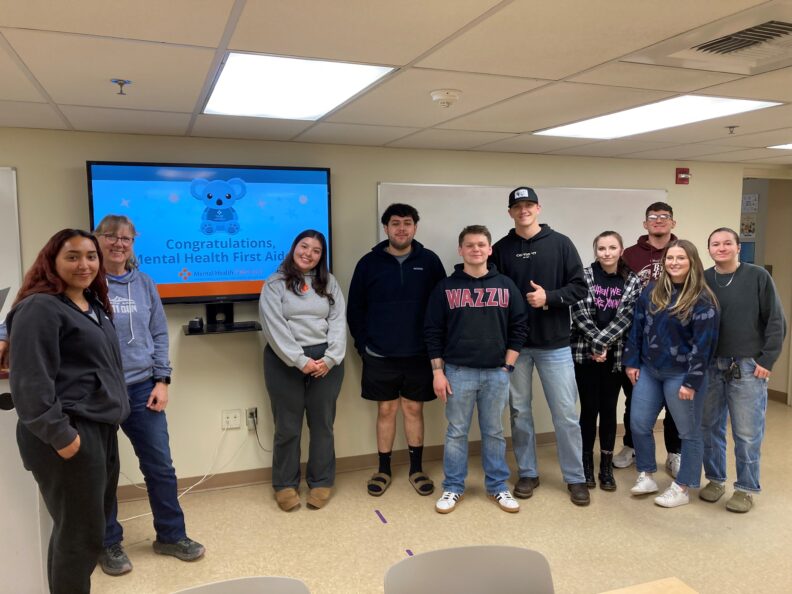
Lutze’s expertise in the field was invaluable as she guided students through the MHFA program, equipping them with the knowledge, skills, and confidence to identify and respond to mental health issues. This training provided students with a unique opportunity to learn how to identify individuals who may be experiencing a mental health crisis, safely assess the situation, communicate effectively, and provide support until qualified professionals may respond. This training will assist students to support their future colleagues in criminal justice, victim advocacy, and social work as well as serving the public good as professionals in the field.
As a faculty member who has taught and mentored students in our department, Lutze is dedicated to supporting student success and well-being. By offering this training, she aimed to empower students with the tools they need to navigate the complexities of mental health and provide essential support to their peers and throughout their careers. We are grateful for Lutze’s leadership and commitment to promoting a culture of understanding and empathy within our department. Her efforts will undoubtedly have a lasting impact on our students’ lives and academic journeys.